Sat, Oct 10, 2026 · Geography
Peakle #2: U.S. cities by population
2025 city-proper estimate for New York only was recorded in the research notes. Later cities were not copied into this guide.
Updated 2026-10-10
Issue #2 (Sat, Oct 10, 2026) uses the category “U.S. cities by population.” I group it under Geography. The public source I used is 2025 city population estimates cited in the 2026-10-25 research. Unit: people, city proper.
Difficulty: Easy summit. Metro areas are the trap. The spread I can defend from that source: New York City 8,584,629 on the 2025 city-proper estimate used here.
How I would climb it
- Use city proper, not the metro area.
- New York is the summit on this estimate.
- Los Angeles is next, but do not swap in a metro figure.
What one recorded New York estimate can and cannot establish
This replay has a deliberately narrow independent public reference: the recorded 2025 city-proper population estimate for New York City is 8,584,629 people. City proper means the city boundary used by that table, not the wider metropolitan population associated with the same familiar name. Both measurements count people, but equal units do not make their geographical boundaries interchangeable. A metro total cannot be substituted merely because its label includes New York. The available notes do not contain numerical rows for the other cities, so this guide cannot provide a documented low, middle, and high ladder or claim to reproduce the complete answer list.
Read 8,584,629 as a count of people, not as 8,584,629 thousand people. Expressed in millions, the same quantity is 8.584629 million; changing the display scale does not create a different population. This is the useful deterministic conversion supported by the single recorded value. A difference between New York and another city would require a second verified city-proper estimate from the same year and methodology. Without that second row, even an apparently familiar ordering cannot establish the size of a step or support a promised multistep route. New York is identified as the leading city in the referenced estimate, but that statement is not a game acceptance test.
Before spending a replay attempt, inspect the category's source line and check that its year, boundary definition, and population column agree with this comparison. Then locate any proposed additional city in that same table and record its exact value before planning a sequence. Check the answer selector for the city identity instead of asserting that NYC, New York, and New York City are interchangeable accepted inputs; the source label alone cannot prove that. A direct opening with the reference leader can reach the summit if the replay uses that dataset. Building a longer climb is optional, and strictly increasing recognized values are sufficient regardless of how close they are. The missing city rows remain missing rather than being filled with remembered metropolitan numbers.
The public archive confirms the date and category for #2. The figures below come from the named public reference, not a purchased replay. A reference number does not establish the game's accepted spelling, exact stored value or source revision.
Reference head of the list
| Name | Value |
|---|---|
| New York City | 8,584,629 |
2025 city-proper estimate for New York only was recorded in the research notes. Later cities were not copied into this guide.
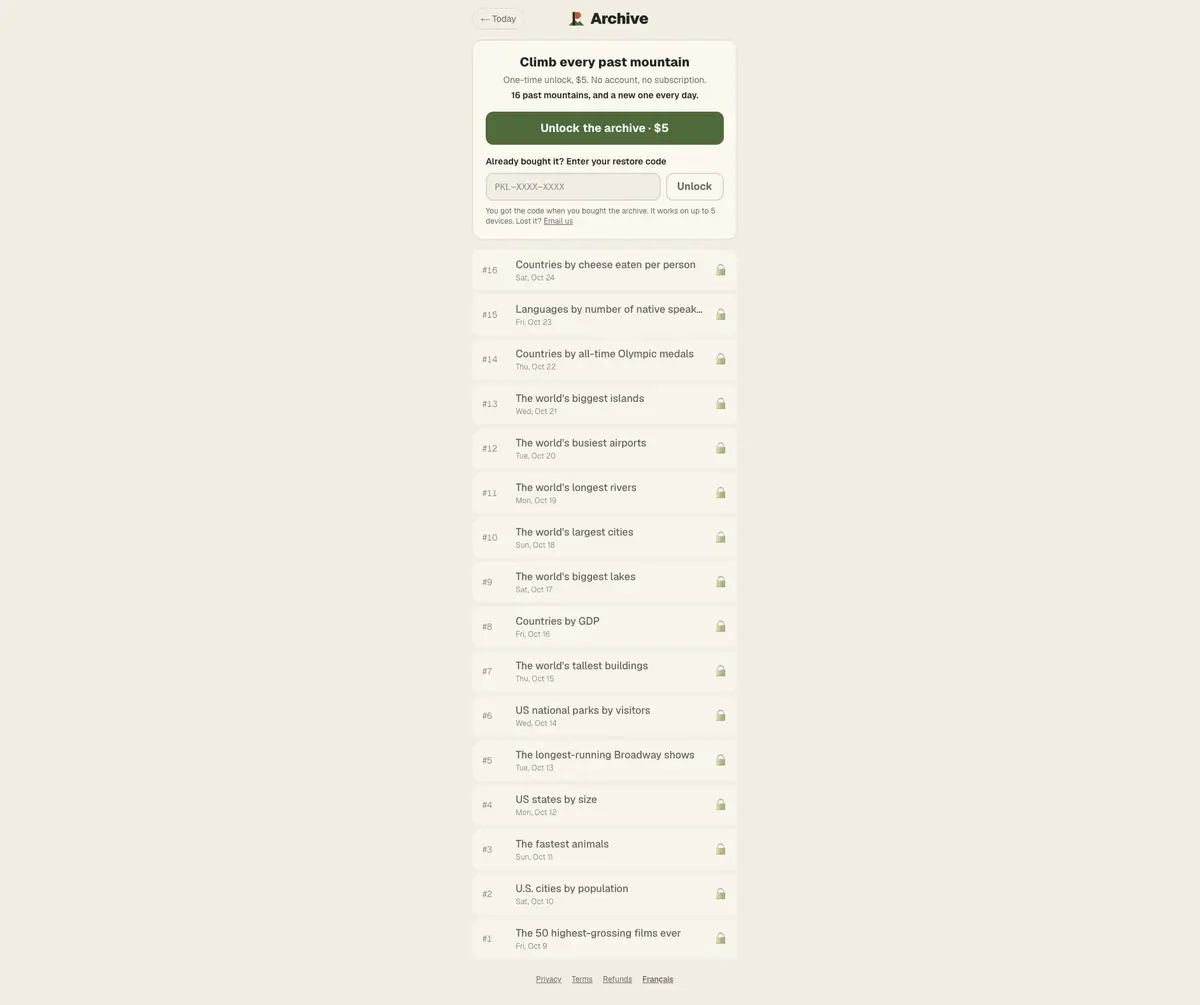
Read the pattern again on the geography category guide, the archive overview, and how to play Peakle.
Previous mountain: Peakle #1 (The 50 highest-grossing films ever).
Next mountain: Peakle #3.
Questions people ask
What was Peakle #2?
On 2026-10-10 the category was “U.S. cities by population.”
Are these the official scored answers?
2025 city-proper estimate for New York only was recorded in the research notes. Later cities were not copied into this guide.
Sources
The Updated date on this page is the day these facts were checked against the linked pages. Reference values from public tables are not a copy of the game's scored list.
Wikipedia reference tables are attributed to the linked articles and their contributors under CC BY-SA 4.0. We select rows, shorten names and sometimes round values; adapted table content is shared under the same license. See the source article history for revisions.