Sun, Oct 11, 2026 · Entertainment
Peakle #3: The fastest animals
Modes are mixed on the public table. The game may pick one mode.
Updated 2026-10-11
Issue #3 (Sun, Oct 11, 2026) uses the category “The fastest animals.” I group it under Entertainment. The public source I used is Wikipedia speed table mixing dive, flight, land, and swim. Unit: km/h, mixed modes.
Difficulty: Hard, because the column mixes different kinds of speed. The spread I can defend from that source: Peregrine falcon dive about 389 km/h. Cheetah land speed is far lower.
How I would climb it
- Read which speed the category wants before you name a cheetah.
- On the mixed public table, the peregrine dive is the summit.
- Do not compare a dive, a sprint, and a swim as if they were one ruler.
Keep the movement mode attached to every animal speed
The independent public reference for fastest animals mixes movement modes, so its speed column cannot be read as a ranking of running ability. The peregrine falcon's 389 km/h describes a dive, while the cheetah entry describes land movement and the Mexican free-tailed bat entry describes flight. Within the recorded group, frigatebird at 153 km/h is a lower reference, white-throated needletail at 169 km/h is an intermediate reference, and the peregrine dive is the upper reference. Those positions describe this mixed public table only. If the replay instead restricts the category to land animals or level flight, the same summit conclusion does not follow.
The Eurasian hobby and Mexican free-tailed bat are both listed at 160 km/h. Their difference on those displayed figures is zero, so moving between them is not a strictly greater step. By contrast, the needletail exceeds either by 9 km/h: closeness does not invalidate that increase. Golden eagle is presented as a range of 240-320 km/h, not an unexplained single score. The peregrine figure exceeds even that range's upper endpoint by 69 km/h. These calculations explain the recorded comparison without deciding which endpoint a game stores. Likewise, the cheetah source distinguishes quoted speed ranges from a more rigorously measured figure; a player should not silently replace one with another.
Prepare a small note with separate columns for animal identity, movement mode, speed unit, and whether the value is a point or a range. Read the source row for white-throated needletail carefully because its longer label includes swift, but do not infer that either spelling is an accepted game alias. Check the available answer identity before submitting it. Sorting the numerical column is useful only after deciding which modes and endpoint policy belong to this replay. Multiple intermediate animals are an optional challenge rather than a condition of success. If dives are included and the game's values match this independent comparison, the peregrine can be a first-answer summit instead of a mandatory last step.
The public archive confirms the date and category for #3. The figures below come from the named public reference, not a purchased replay. A reference number does not establish the game's accepted spelling, exact stored value or source revision.
Reference head of the list
| Name | Value |
|---|---|
| Peregrine falcon (dive) | 389 km/h |
| Golden eagle | 240–320 |
| Gyrfalcon | 209 |
| White-throated needletail | 169 |
| Eurasian hobby | 160 |
| Mexican free-tailed bat | 160 |
| Frigatebird | 153 |
| Cheetah (land) | 109–121 |
Modes are mixed on the public table. The game may pick one mode.
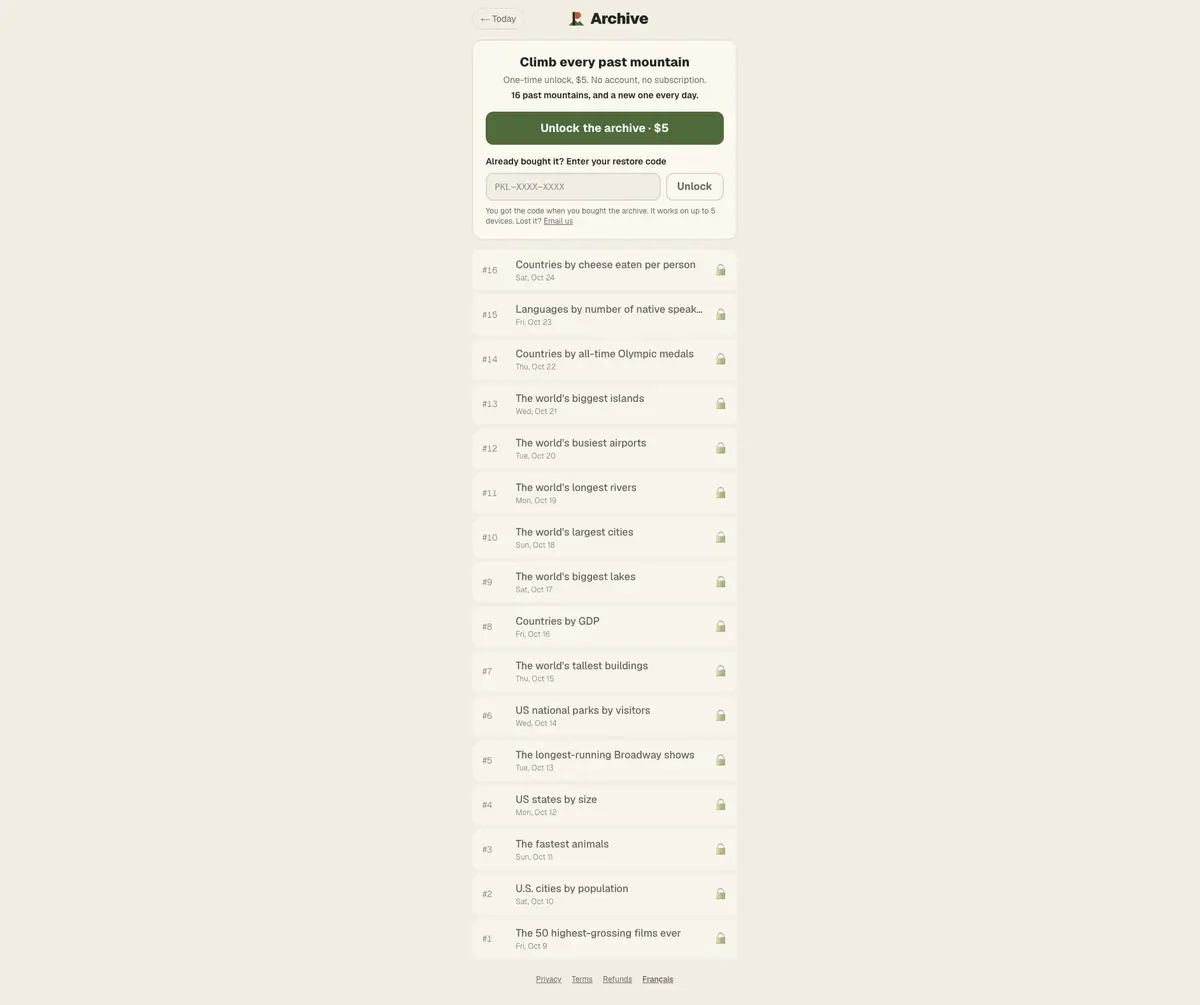
Read the pattern again on the entertainment category guide, the archive overview, and how to play Peakle.
Previous mountain: Peakle #2 (U.S. cities by population).
Next mountain: Peakle #4.
Questions people ask
What was Peakle #3?
On 2026-10-11 the category was “The fastest animals.”
Are these the official scored answers?
Modes are mixed on the public table. The game may pick one mode.
Sources
The Updated date on this page is the day these facts were checked against the linked pages. Reference values from public tables are not a copy of the game's scored list.
Wikipedia reference tables are attributed to the linked articles and their contributors under CC BY-SA 4.0. We select rows, shorten names and sometimes round values; adapted table content is shared under the same license. See the source article history for revisions.