Sun, Oct 18, 2026 · Geography
Peakle #10: The world's largest cities
UN 2025 urban agglomeration. City proper Jakarta is about 10,154,134.
Updated 2026-10-18
Issue #10 (Sun, Oct 18, 2026) uses the category “The world's largest cities.” I group it under Geography. The public source I used is UN 2025 urban agglomeration figures cited in the 2026-10-25 research. Unit: people, urban agglomeration.
Difficulty: Hard. City proper is a different list. The spread I can defend from that source: Jakarta agglomeration 41.9 million versus city proper about 10.2 million.
How I would climb it
- Decide agglomeration versus city proper before the first name.
- On the UN 2025 agglomeration column, Jakarta is the summit.
- Do not mix a city-proper number into an agglomeration climb.
Read the urban-agglomeration column rather than a city-boundary neighbor
The independent public reference for this replay is the UN 2025 urban-agglomeration comparison. It measures people in the table's agglomeration definition rather than simply the population inside a municipality. The recorded leading group runs from Manila at 24,735,305 through intermediate entries such as Delhi at 30,222,405 to Jakarta at 41,913,860. Manila is lower within these selected rows, not a proposed minimum among every city in the source. A familiar city name can appear beside several valid population figures with different geographical boundaries, so treating every number on its row as the same measurement would undermine the entire ordering.
Jakarta illustrates the boundary issue directly: its agglomeration figure is 41,913,860, while the recorded city-proper figure is 10,154,134. Subtracting gives 31,759,726 people, a difference between geographical definitions rather than evidence of sudden population growth. Within the agglomeration column itself, Jakarta exceeds Dhaka's 36,585,479 by 5,328,381. Delhi exceeds Shanghai's 29,558,908 by 663,497. Shanghai followed by Delhi is thus a positive step on this reference even though their populations occupy a similar range. No rule requires a larger population gap; the practical risk lies in choosing the wrong boundary or column, not in a close but correctly ordered pair.
Before replaying, locate the precise heading for the UN 2025 comparison and write down the boundary definition beside any copied city value. Do not substitute a municipality, an urban-area column from another compiler, or a metropolitan estimate just because it is nearby on the page. Check the selector for the city identity and its scope; a label such as Tokyo or Jakarta does not by itself prove which administrative or urban unit the game uses. No alternate spelling is asserted as an accepted alias here. Several cities can form an optional upward practice sequence after the dataset is matched. If the replay uses this reference leader, Jakarta can instead be a first-answer summit without traversing those intermediate populations.
The public archive confirms the date and category for #10. The figures below come from the named public reference, not a purchased replay. A reference number does not establish the game's accepted spelling, exact stored value or source revision.
Reference head of the list
| Name | Value |
|---|---|
| Jakarta | 41,913,860 |
| Dhaka | 36,585,479 |
| Tokyo | 33,412,512 |
| Delhi | 30,222,405 |
| Shanghai | 29,558,908 |
| Guangzhou | 27,563,372 |
| Cairo | 25,566,102 |
| Manila | 24,735,305 |
UN 2025 urban agglomeration. City proper Jakarta is about 10,154,134.
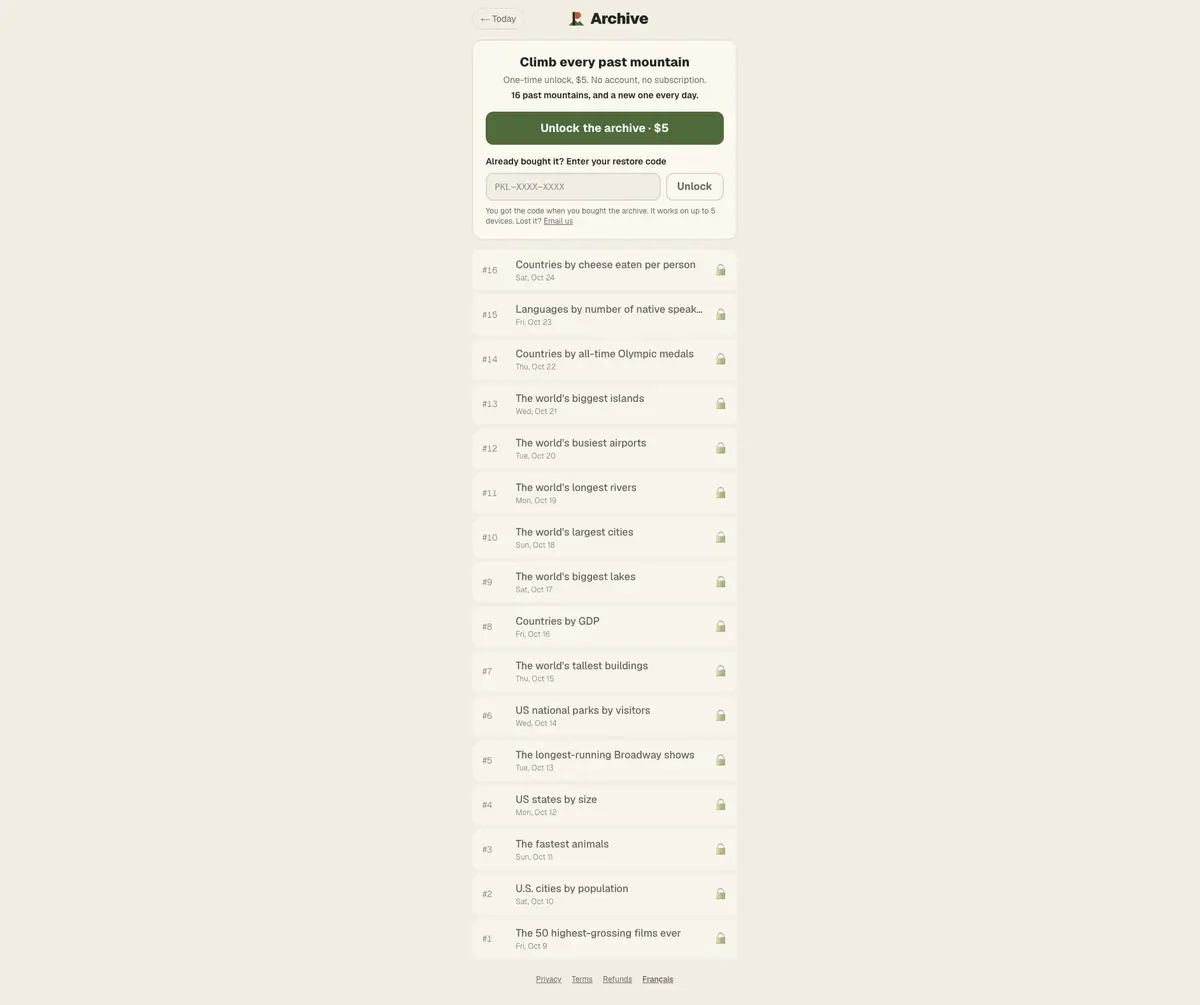
Read the pattern again on the geography category guide, the archive overview, and how to play Peakle.
Previous mountain: Peakle #9 (The world's biggest lakes).
Next mountain: Peakle #11.
Questions people ask
What was Peakle #10?
On 2026-10-18 the category was “The world's largest cities.”
Are these the official scored answers?
UN 2025 urban agglomeration. City proper Jakarta is about 10,154,134.
Sources
The Updated date on this page is the day these facts were checked against the linked pages. Reference values from public tables are not a copy of the game's scored list.
Wikipedia reference tables are attributed to the linked articles and their contributors under CC BY-SA 4.0. We select rows, shorten names and sometimes round values; adapted table content is shared under the same license. See the source article history for revisions.