Peakle business and sport categories
Three mountains where the number is money or units, not a place. Each one has a different source year.
Updated 2026-11-03
Peakle usually asks for a place, a length or a population. This group is the exception: the answer is a product total, a company revenue or a team valuation. The arithmetic is still strictly higher, but the unit and the snapshot year matter more than the name.
- #20 best-selling car models — units over each nameplate's life, as of 14 October 2026. Toyota Corolla 50,000,000 and Ford F-Series 43,000,000 lead. Camry and Fiesta tie at 22,000,000.
- #21 Fortune 500 companies — 2026 revenue for the latest fiscal year, as of 2 October 2026. Amazon $716.9B and Walmart $713.2B lead; Alphabet $402.8B and CVS $402.1B are a $0.7B step.
- #24 most valuable sports teams — Forbes 2025 valuation, USD, as of 31 December 2025. Dallas Cowboys $13.0B; the Giants $10.1B and Lakers $10.0B are a $0.1B step.
The unit is the category
A car model's lifetime units are not this year's sales. A company's revenue is not its profit, market value or assets. A team's valuation is not its payroll or its league's media deal. Each page names the column and the date because a different year or a different definition produces a different order.
Two pairs are close enough that rounding decides them: Alphabet and CVS at $402.8B and $402.1B, and the Giants and Lakers at $10.1B and $10.0B. A guide that prints whole billions without the decimal hides the step. The car list has a true tie at 22,000,000 between Camry and Fiesta, so a step between those two is not a valid increase.
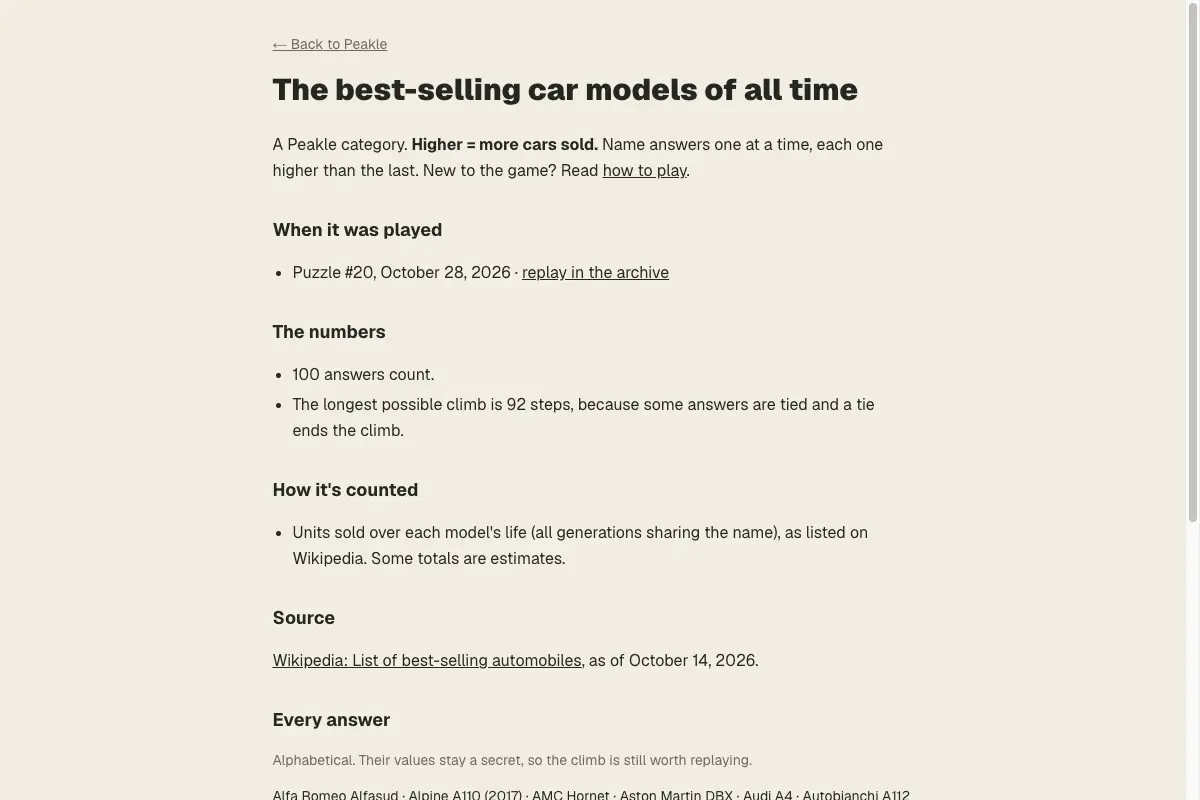
Read the individual pages for the reference tables and the replay notes: best-selling cars, Fortune 500, sports teams. The full list is on Peakle categories.
Questions people ask
Why are cars, revenue and teams in one group?
They share a number that is not a place: units sold, annual revenue or a valuation. The group is an editorial sort, not an official Peakle taxonomy.
Can I mix the source years?
No. The car list is checked to 14 October 2026, the Fortune 500 is the 2026 list and the team values are Forbes 2025. A different year is a different column.
Sources
The Updated date on this page is the day these facts were checked against the linked pages. Reference values from public tables are not a copy of the game's scored list.
Wikipedia reference tables are attributed to the linked articles and their contributors under CC BY-SA 4.0. We select rows, shorten names and sometimes round values; adapted table content is shared under the same license. See the source article history for revisions.