Wed, Oct 14, 2026 · Travel
Peakle #6: US national parks by visitors
2025 recreation visits. A different year moves the middle of the list.
Updated 2026-10-14
Issue #6 (Wed, Oct 14, 2026) uses the category “US national parks by visitors.” I group it under Travel. The public source I used is 2025 recreation visits, 64 parks. Unit: 2025 recreation visitors.
Difficulty: Easy if you know the Great Smoky cliff. The spread I can defend from that source: Great Smoky Mountains 11,527,939. Lowest cited park, Gates of the Arctic, 7,786.
How I would climb it
- Open on a remote park such as Gates of the Arctic, not on Yosemite.
- Great Smoky Mountains is the summit on the 2025 visit column.
- Yellowstone to Zion is higher on this column; reversing that order ends the run.
Count recreation visits to national parks, not every park-service destination
The independent public reference uses the 2025 recreation-visits column for US national parks. A visit count is not park area, a count of distinct people, or a ranking of every kind of National Park Service site. Gates of the Arctic has a recorded 7,786 visits and provides a genuinely low reference; Grand Teton at 3,800,648 offers a much higher intermediate anchor; Great Smoky Mountains at 11,527,939 is the recorded summit. Keeping the designation and year attached to these values prevents a famous monument or another year's attendance from slipping into an otherwise numerical comparison. These reference counts are not game-verified replay reveals.
The upper reference is separated from Zion, at 4,984,525, by 6,543,414 visits. That gap is substantially larger than the difference between Zion and Yellowstone: 221,537 visits using Yellowstone's 4,762,988. Yellowstone followed by Zion is an increasing pair in this column, not a guaranteed loss just because both parks are popular. At another point in the selected group, Yosemite's 4,278,413 exceeds Rocky Mountain's 4,171,431 by 106,982. Strictly greater is the relevant condition; a large cushion is a planning preference, not a separate game rule. Carry exact visit counts into the comparison instead of flattening several parks into a rounded four-million bucket.
Before replaying, find the recreation-visits heading for 2025 and verify that the row is the national park intended by the category. Keep Great Smoky Mountains, Grand Teton, and Gates of the Arctic attached to their full park identities rather than substituting a nearby mountain range or another protected site. Check the game's available selector labels instead of claiming that shortened park names are accepted aliases. If several steps are your chosen target, sort the relevant recorded rows upward and leave the summit until the desired point. If a fast summit is the target and the stored dataset agrees, Great Smoky Mountains can be the first answer. The optional longer sequence does not make an immediate finish less valid.
The public archive confirms the date and category for #6. The figures below come from the named public reference, not a purchased replay. A reference number does not establish the game's accepted spelling, exact stored value or source revision.
Reference head of the list
| Name | Value |
|---|---|
| Great Smoky Mountains | 11,527,939 |
| Zion | 4,984,525 |
| Yellowstone | 4,762,988 |
| Grand Canyon | 4,430,653 |
| Yosemite | 4,278,413 |
| Rocky Mountain | 4,171,431 |
| Acadia | 4,079,318 |
| Grand Teton | 3,800,648 |
2025 recreation visits. A different year moves the middle of the list.
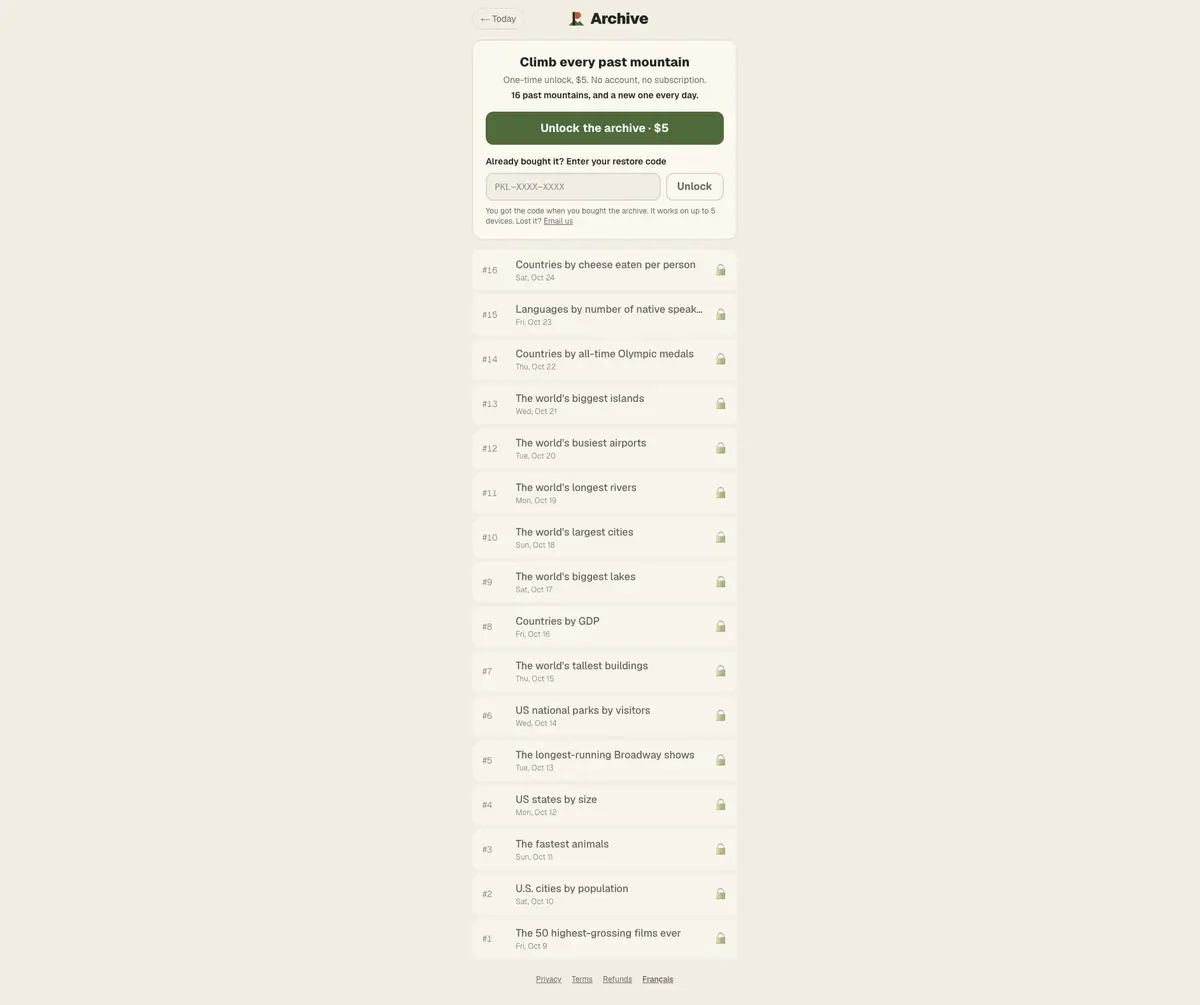
Read the pattern again on the travel category guide, the archive overview, and how to play Peakle.
Previous mountain: Peakle #5 (The longest-running Broadway shows).
Next mountain: Peakle #7.
Questions people ask
What was Peakle #6?
On 2026-10-14 the category was “US national parks by visitors.”
Are these the official scored answers?
2025 recreation visits. A different year moves the middle of the list.
Sources
The Updated date on this page is the day these facts were checked against the linked pages. Reference values from public tables are not a copy of the game's scored list.
Wikipedia reference tables are attributed to the linked articles and their contributors under CC BY-SA 4.0. We select rows, shorten names and sometimes round values; adapted table content is shared under the same license. See the source article history for revisions.